
2026 was a pretty productive year as releases go.
We did not only see the vinyl version of MAX, we also got Atlas, and, scheduled for St. Nicolas Day, minmax.
And now, we have Drei Karten.
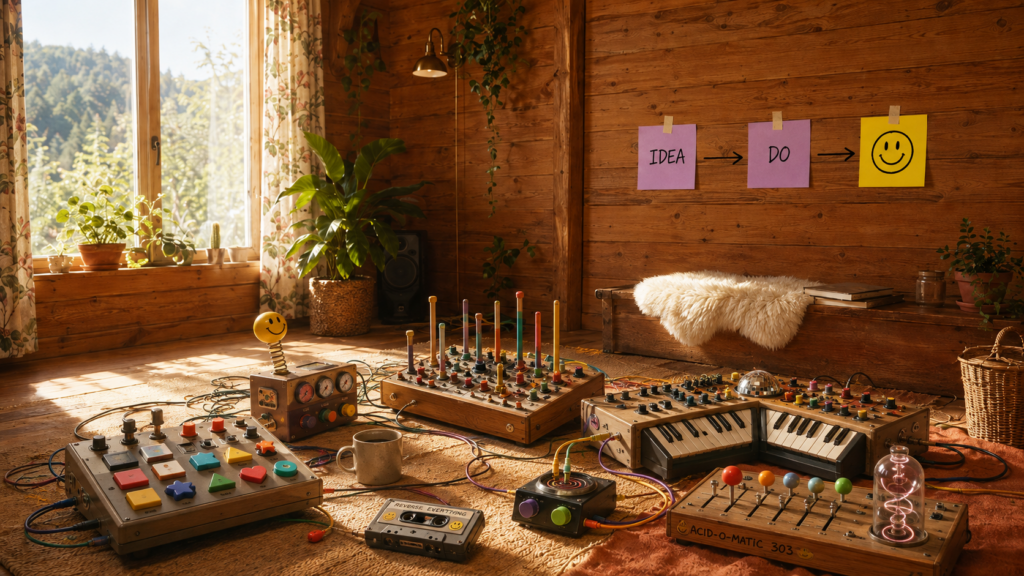
Going Agile
Before the event that was our Wellness Creative Retreat, we had already discussed some aspects of the way of working, as well as some thing we might want to accomplish. Such as going for a radically lean Kanban with postits on a wall, or that we wanted to create a collaborative Music Weeklies track.
Given our travel plans, we agreed on inspection of the venue, commissioning and a test run after our arrival on Monday afternoon. We did that, including sticking some postits with ideas onto the wooden wall of the hut we stayed in. Nothing much else happened on Monday.
Tuesday, our first full day, was almost completely filled with the a single Kanban card: the Music Weeklies-related one. Which made sense in a way: we were new to the place, we hadn’t worked together in a similar fashion before, so consider this as the Spring Zero equivalent. And the track was nice.
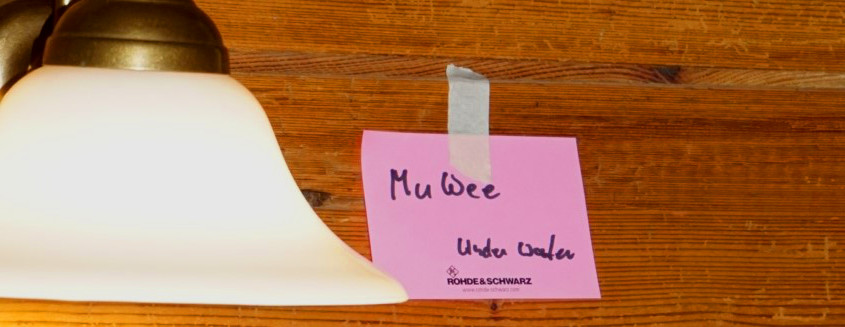
Full Velocity for Day Two
In an attempt to judge velocity, we would have found that it was very low on day one, and a lot was left to do. We did not do that.
Instead, we pulled cards and worked on the for the second day.
I played a few chord changes for a remix that Rolando had been busy with literally for years. He provided some alternate drum parts for a MC-707 project that I had already used for a video. We did a silly short inspired by a silly (his words) song by Alex Ball. We took two keyboards and played a jazz ditty that I had written for Wolfi Schlick, inspired by a Coltrane original.
And there was the OG Acid Techno card.
We mostly fired up the machines (TR8S and MC707, two MPCs, SP404 and one or two TD-3s, and some effects) and just turned knobs and switched patterns. And at one point decided „that’s that“, and pressed stop. The recorder showed roughly 59 minutes. We identified that we could also move the „SP-404“ and „mixing in mono“-related cards. Three cards.
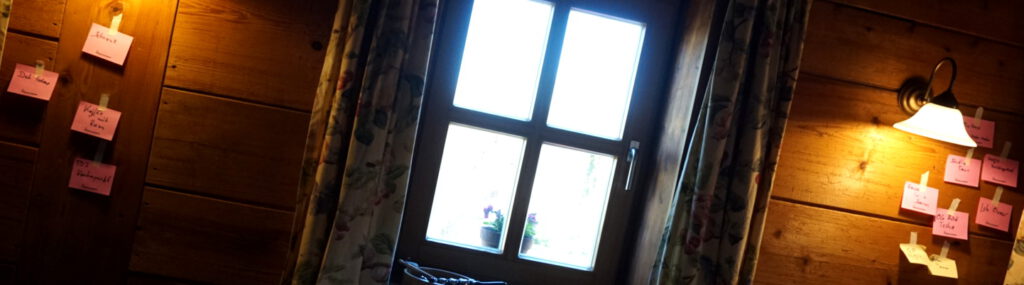
Drei Karten.
Done for the day.
Did it work?
Workflow-wise: absolutely. Having such an extremely slim approach (short statements on each card, not even proper lanes, things happen very hands-on and quick) did not only not conflict with creative progress, but was also a lot of fun to do. We always saw what we had planned. And what we had done. And what we just might ignore. Or add.
The relatively small productivity for day one was, as we judged it, down to a number of things. We had to learn the actual setup. And the way of working. And working together with each other. And we had started with the most complex task. Seeing this the other way ‚round: on day two, we had worked on five tracks, after starting around 10, and were done by mid-afternoon. That was an accomplishment.
So our takeaways?
- retain the approach
- increase the number of days. Three full days a minimum, four (plus preparatory evening) maybe the optimum.
On the Music
Drei Karten is unique.
I have released albums since 1989, and since then, released dozens of them. I’ve done simple albums and complex ones. There were different musical styles and production approaches. Work on the albums end to end ranged from a few months to many years. Some included lots of additional talent, others were solo-flight affairs all the way. There were solo albums, and albums by ensembles that I had led or co-led, or acted as the sole composer for.
But this one is the first one that is truly a collaborative one with two artists equally involved in the creation. That is new.
The music? Forget about OG Acid Techno and stuff for a moment, that’s not so far from things that I had done already.
So the big musical change, in a way, also had to do with work organization.