
I recently did my Pedalboard 2.0, which offers some vast improvements over Pedalboard 1.0.
One thing available for both: it gives me four channels from a two-channel amp. Sort of.
Building Blocks and Scope
The focus today is on what is perceived as the „amp channels“. Which refers to the preamp in an electric guitar signal flow. We won’t discuss other things – like effects, and how in detail the signal routing is achieved. The preamp portion of the signal flow takes centre stage.
As for our relevant building blocks:
- The amp: an ENGL Steve Morse Signature 20. A tube amp with two channels (named „clean“ and „lead“), and switchable boost.
- The preamp pedal: Boss MT-2w Metal Zone.
- The EQ/boost bedal: Empress ParaEQ Mk.II deluxe. It offers lots of EQ, and lots of boost.
The Eventide H90 takes care of the signal routing. Everything I do to change channels happens with a total of three footswitches.
The Channels
The numbering here is my own well-ordering.
Items in the signal flow in square brackets are things I can add for flavour (they’re boosts).
Channel 1: Ultra-Clean with a Twist
Signal Flow: Guitar -> Empress ParaEQ -> [Empress Boost] -> ENGL Power Amp
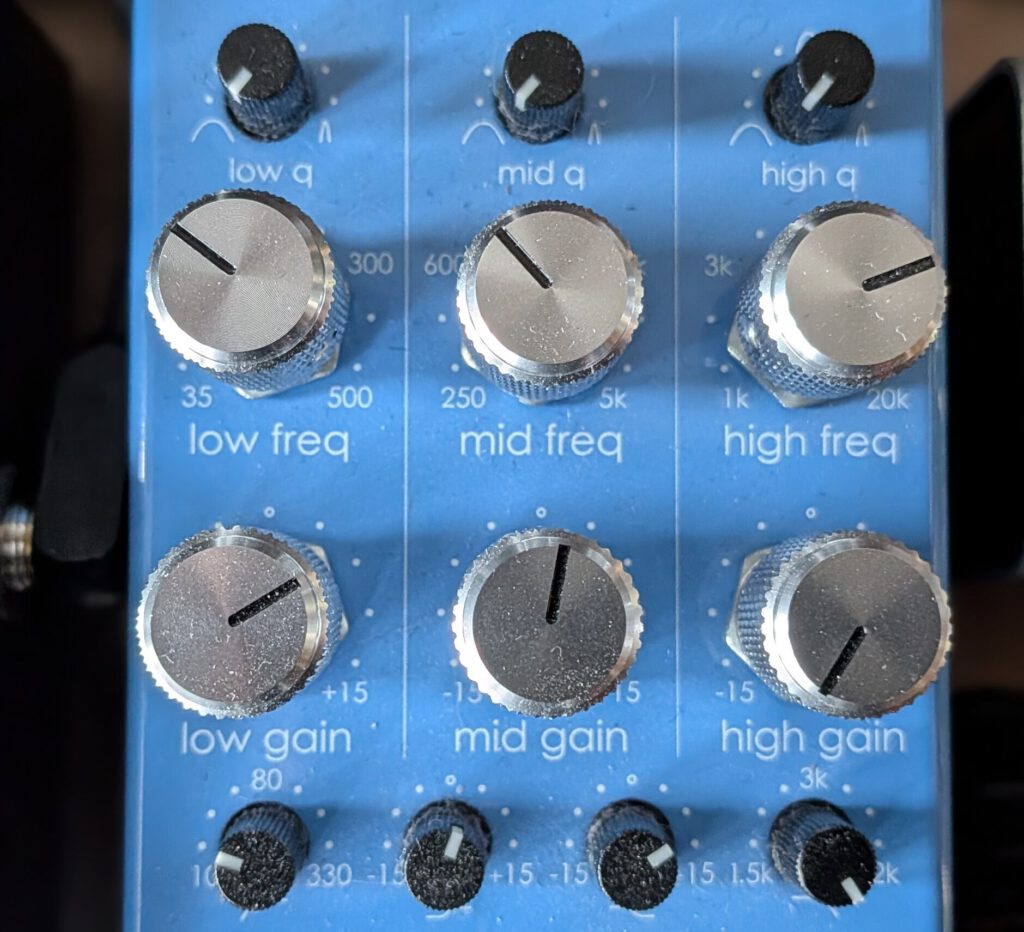
No thing that distorts of any way. This is audio-engineering-clean, not guitar-amp-clean.
For the EQ choices, the top row sets all the parametric bands to their minimum Q (sadly, the lower end is 1). We then boost lows, a tiny bit of low mids, and turn high frequencies completely down around 7kHz. Won’t that make it dull? No, because there’s substantial boost from the high-shelf. Air band!
The lowcut takes away everything below a seven-string guitar (but nothing above), and the low shelf offers a bit more of low frequency.
This is a very full, never harsh, sound. Fantastic with the neck pickup of the QX!
What about the optional boost? This boost has lots of gain (40dB). So you can drive the ENGL’s power amp to give you a flavour of distortion not available anywhere else. It’s very evil.
Channel 2: Clean
Signal Flow: Guitar -> [Empress Boost] -> [ENGL Boost] -> ENGL Clean Channel -> ENGL Power Amp
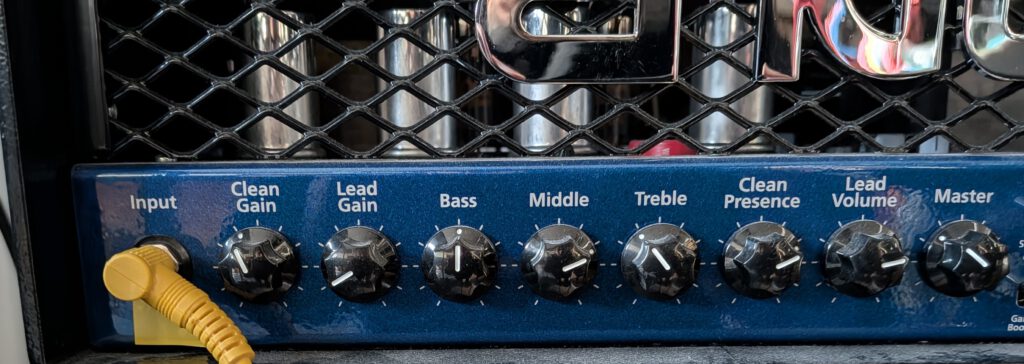
What guitarists mean when they say „clean“. With the clean gain at 11 o’clock, this one just starts to crunch without boost at full guitar volume and with loud playing. Adding either (or both) of the boosts changes that to a perfectly sensible blues-rock lead sound that never gets metal.
For EQ choices, this is a noticeable mid-boost and gentle treble rollof – and we get some sparkle back via the „Clean Presence“ knob.
Channel 3: Factotum
Signal Flow: Guitar -> [Empress Boost] -> MetalZone -> ENGL Power Amp
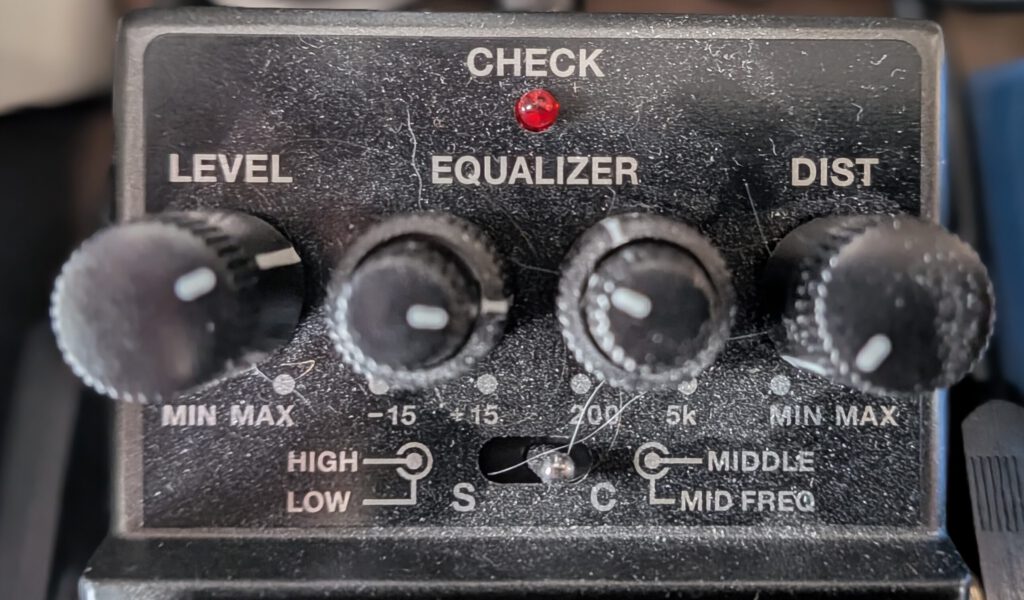
A MetalZone with DIST at minimum setting? Hear me out, you might learn something.
If you play the MetalZone very softly (i.e. DIST at minimum, and potentially guitar volume turned down), it doesn’t distort. There’s a reason for it: we get an input buffer, then an opamp-based amp (gain controlled with the DIST knob) that goes 6…48dB, and then a symmetrical clipping stage that clips around 0.3V. So: if you have a run-of-the-mill singlecoil, turn down your guitar volume and play softly – it stays clean, right? It does. If you turn up your guitar’s volume and start playing loud, you get an onset of clipping.
That’s before we hit the Empress‘ boost. Do that, and you start to saturate the input FET buffer. Then hit the opamp with full level, try to amplify (meaning: OpAmp distortion), and then hit the clipping diodes. Heavily. Metal Heaven.
The MetalZone is known for a pretty powerful EQ – low and high, plus sweepable mids. It does have more static EQs inside, though, the one most relevant is the very bandpass-y static one. Which works nice for those heavily distorted tones, but: if you don’t hit it hard, there’s the static bandpass, followed by my scooped settings, which mostly evens out.
Hit it hard, and you get a very well-defined, but extremely angry metal sound with lots of scoop.
If I had only one channel available, I’d choose this one.
Channel 4: Lead
Signal Flow: Guitar -> [Empress Boost] -> [ENGL Boost] -> ENGL Lead Channel -> ENGL Power Amp
Returning to the ENGL, we switch to its lead channel.
Even with the gain almost fully down, it likes to distort. We once again have two boosts at our disposal, so even with the mid-focused EQ (the ENGL only has one EQ, and the Presence knob does not affect the lead channel on the Steve Morse Signature 20), this is also metal. But a different metal, more of an industrial, gritty, Kreator metal.
Setting Levels
Levels are an optimization problem. You can adjust the output of the Metalzone, and the one of the ENGL’s lead channel. And every channel’s input gain safe for the Ultraclean one. Luckily, I was able to find a solution to the problem – in this setting, it somehow works together with the Ultraclean one. Also because I have that huge boost to shake up things. And I usually want to be slightly louder when playing slightly distorted.
Summarizing
A fun exercise. I got a lot of different sounds out of a small two-channel amp. And not only that:
Those are four distinct topologies. So not just „faking an additional channel“, but four proper channels. And the workflow works to support it, too: you switch channels with a foot pedal, like you always do.
If I had to pick my two big learning exercises:
- hitting the poweramp with a much too loud ultraclean signal,
- hitting the Metalzone with a very soft signal.