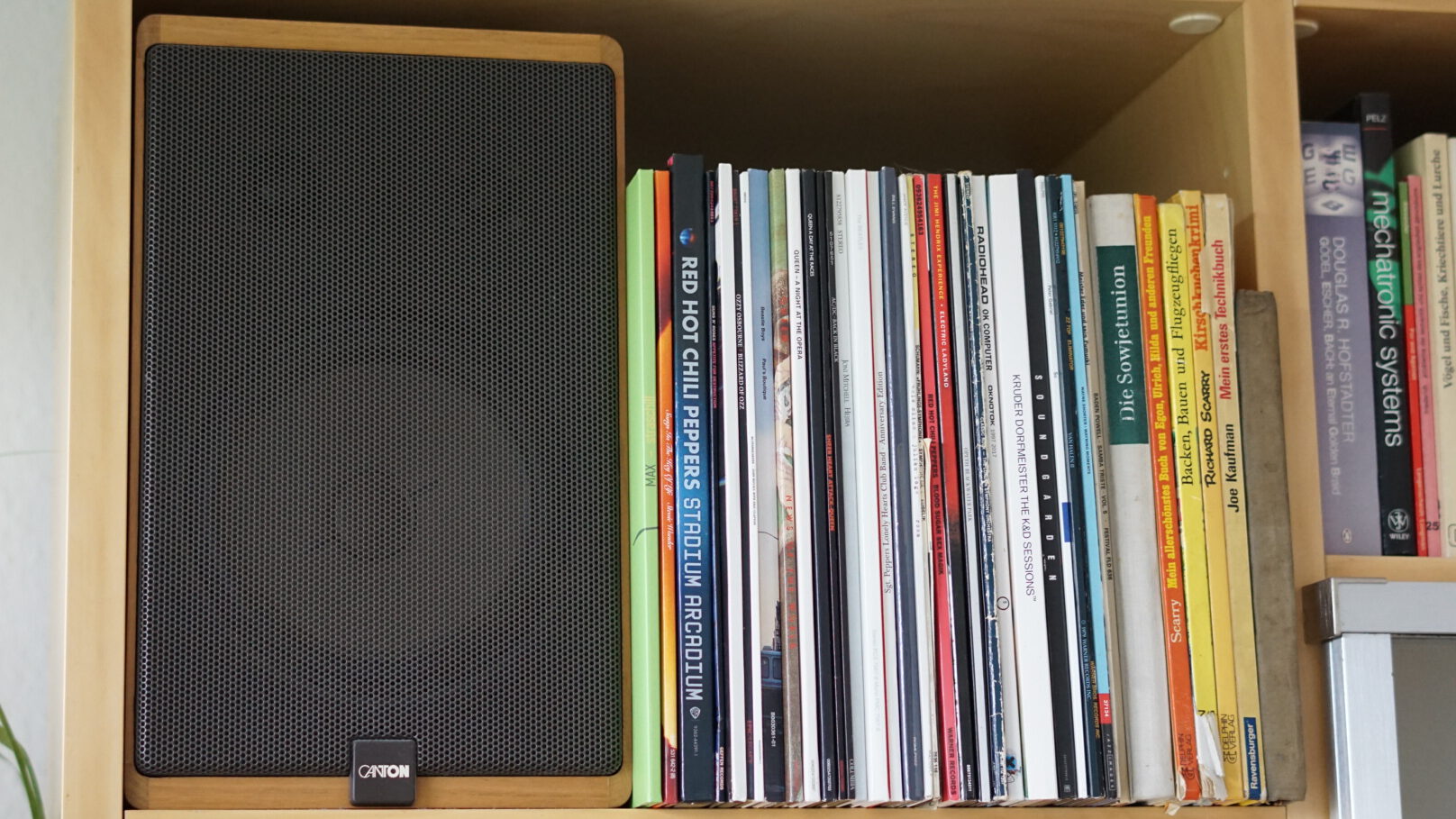
MAX cost about ten grand.
It recouped zero.
Which was intended.
So a success from a business perspective.
As presented amply here before, that album followed a production model and work split that is unusual for me. And I believe for amateur productions in general: I did the music composition. I ran the project office. I was what you might call the album’s producer. I provided the funding. Everything else: let experts do the job.
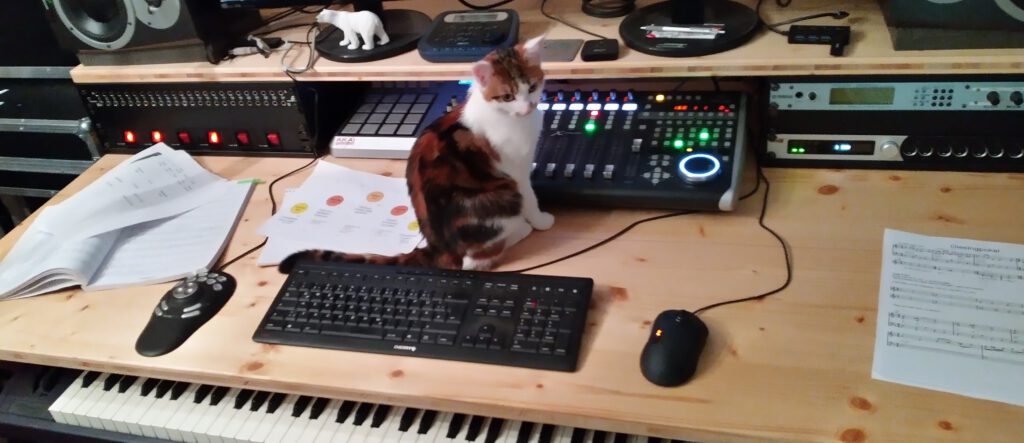
Before spending money: what did I think this would cost?
Before we discuss how much it did cost, let’s ask „how much did I think it would cost?“
Early in the project (ca. 9/24, i.e. before I first posted about it), I had run a few RFIs (requests for indication, i.e. „what’s your ballpark?“) with contributors I had in mind, as well as checking some rates available online.
The sum was about €10’700.
I considered this acceptable.
What actually cost money?
Let’s start with the accounting conventions:
- external cash expenditure only,
- gross cost to me in EUR,
- foreign currency payments converted using the rates from the invoice due date,
- numbers rounded to hundreds (for currency) vs. single digits (for percentage values),
And my own labour excluded.
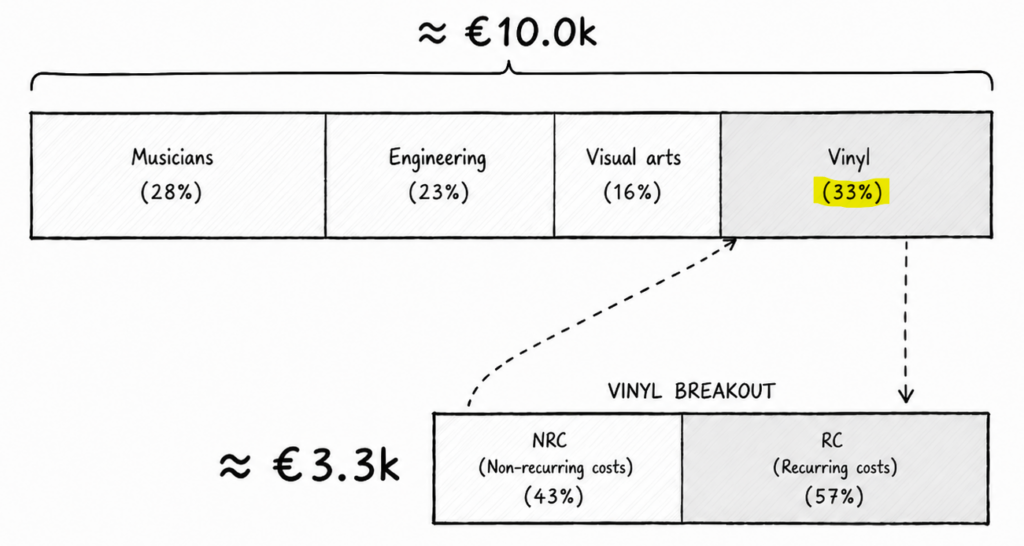
The rounded total: €10’100.
Breaking this down
I decided to break this down into the following categories:
- Musicians: all musician fees – rehearsals, recording sessions and support work (e.g. production of the recording sessions, copyediting). From the score to the sound of the instruments.
- Engineering: all audio engineering work – recording, mixing, mastering, including studios/venues. From the sound of the instruments to the production (pre)master.
- Visual Arts: concept design and realisation of the package for digital and physical product. From the album idea to preprint.
- Vinyl Non-Recurring Costs: Master cut, offset plates, related setup costs. From premaster and preprint to master.
- Vinyl Recurring Costs: The per-piece costs for the run of 100 physical copies of the album. The final stretch to physical copies.
Note that 1-3 describe the different domains/professions involved in getting from the album artists‘ idea to the premaster/preprint. Which would have been all there was if the album was digital-only.
4 and 5 relate only to the physical release, and 5 would also give you the marginal costs for another run of 100 albums.
What did the money buy — and was that actually expensive?
Let me start by explaining that I did not optimise cost after some clear goal. I wanted a nice album. Which also meant: I said „here’s what I want, what will you charge for it“ – no haggling. Because that’s something I’m not good at.
So what did it include?
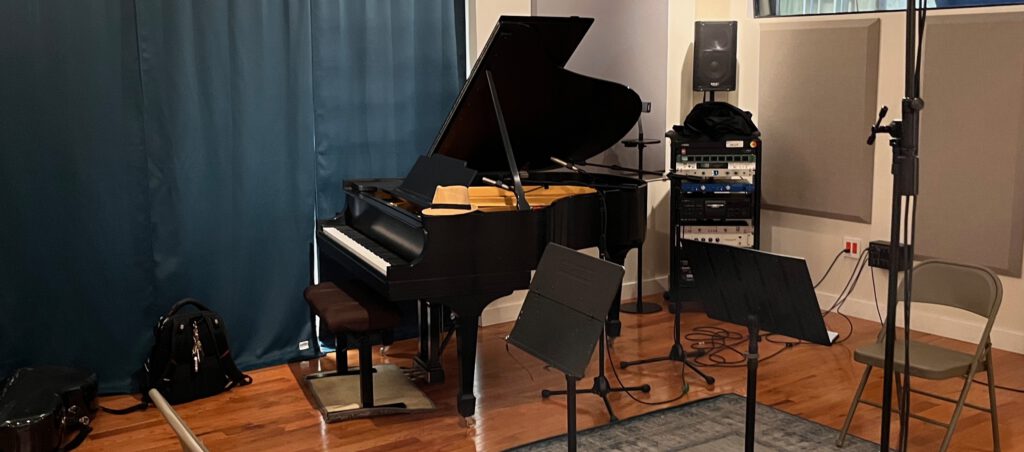
For the musicians, this meant five different ensembles (two soloists, two trios, one quartet), each group separately organizing this part of the production, sourcing and hiring a studio etc.
The studio (both the studio costs and engineers‘ fees) went into engineering, together with the mixing and mastering engineering work (those being independent from the recording engineers, and all recording engineers/venues being different simply for geographical reasons).
Visual arts bought exactly that: „here’s the album idea, I want a digital release and a double album, do something“ – and I got preprints from that.
Finally, vinyl was a small run, and a somewhat more elaborate package (gatefold sleeve, inside-out, printed inner sleeve).
Needless to say, the people involved weren’t amateurs in what they’re doing, holding uni/academy/conservatory degrees and a relevant track record in their field, including Grammy nominations and top-tier credits.
So: whas it „expensive“?
I’d say
- YES, because a good ten grand is a lot of money. Both for an independent artist and for a project that does not aim to recoup any of that.
- NO, because those good ten grand bought top work at a very competitive price, and made the album a top result.
Why does 100-copy vinyl look so expensive?
I opted to highlight one figure in the diagram above: 33% of the grand total for that small run of vinyl. Which is, in fact, pretty expensive in the album’s context. One could have saved one third by simply saying „digital age“ and be done with it.
However, it makes sense to look into the breakdown of recurring vs. non-recurring costs:
43% (or roughly 1.4k€) went into setting things up. Which, for any reasonable run, would be one-time costs. And the remaining 1.9k€ are then marginal costs – which means doing another run of 100 would end up with a per-piece cost of €19.
But again, with the project’s business/no-business case in mind:
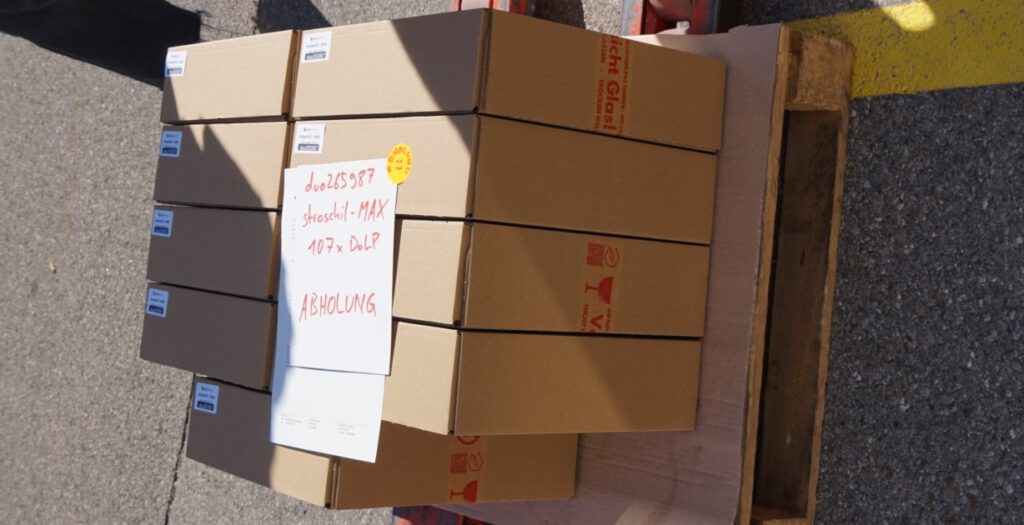
look at how beautiful this turned out!
What if you do not want to make MAX?
In this section, I might want to look into two „what-ifs“ for album projects that anyone (like you) might have on their mind and an attempt at base of estimate writing.
Scenario 1: Same Approach, Different Package
This is easy to calculate, with actual existing quotes:
- For the same album, but a single, nicely packaged CD instead of vinyl: €7.4k.
- For the same album, digital release only: €6.3k.
Scenario 2: Same Approach, Smaller Size
For this, we’ll assume two ensembles, ca. 40 minutes of playing time, and one vinyl record (instead of a double album). And we need to make assumptions so we lose validity of our base of estimate.
- shorter album with single vinyl and less musical diversity: €6.8k.
Just remember: your project is most probably different in some or most ways. So comparisons only go so far.
How good was the original estimate?
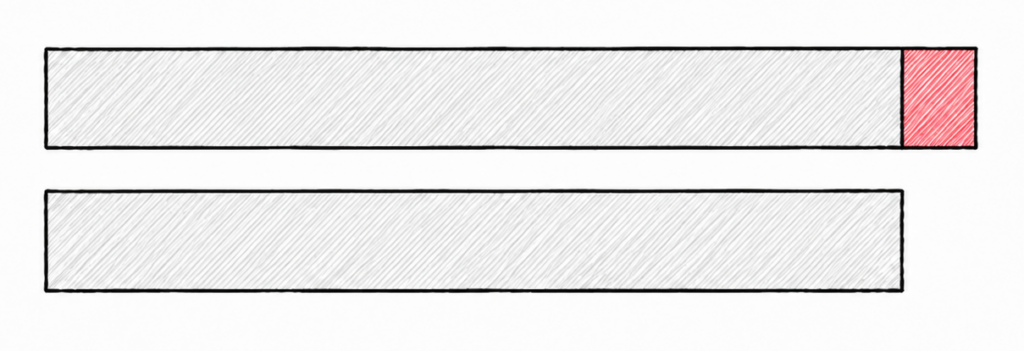
If we compare the estimated €10.7k to our actual €10.1k, I’m not that disappointed: we were ca. €600 off, or less than 6%.
Which means the project did neither overrun dramatically, nor did it come in at only a small fraction of the estimate. Which to me means that the original RFI/cost calculation phase worked pretty well.
I’m not going to claim that each single cost item came in as close to the estimate as this suggests. Some individual positions ran over or under substantially. But it mostly evened out.
But was there any change of scope, maybe to keep costs in check in either direction?
There was one: as you know, Sapientia Salomonis ended up being performed and recorded by me (in clear violation of the album’s production approach). What did I save? I had quotes for musician and engineering work, amounting to…€600. Exactly. The change of scope caused the deviation almost to the euro.
The accounting trick: do it yourself
While I did outsource a lot, there’s also stuff I did myself. Like composing, running the project, what have you. It doesn’t show up in the accounting.
But what would it look like? I did not track hours for most of the project. But I had run the bulk of the composing work in three normal one-week sprints, so if you multiplied that by the number for an hour from my day job’s accounting: you’d get roughly 37k for the bulk of the composition. That’s a lot.
Which, again, reinforces the perception that the „true TCO“ number we looked at above was both really expensive and astonishingly cheap.
Money. A lot? Not much?
So the paradox is really unresolved, because it can’t be.
Ten grand is a ridiculous amount of money for an album (or for anything) that earns nothing.
Ten grand is a ridiculously small amount of money considering the talent that went into making the album, and the way the album turned out.
And it is a small amount if making this album in memory of my late father was what this was about. Or can you put a price tag on grief? On coping? On the memory of a loved one?