
While working on an album (working title: Atlas) I came up with a few scales.
There’s a total of three, two heptatonic ones and one octatonic one.
General Properties
We’re thinking in 12TET (i.e. twelve equally-spaced semitones per octave mindset), and what is known as a Z12 circular group: doubling the frequency (moving up one octave) results in the note „being the same“, technically the same pitch class.
In other words, we work from a set of twelve pitches starting with A and ending with G#, and C3 is the same as C5, and E# the same as F for our line of reasoning.
Context
I’m working on an album right now. The (working) title is „Atlas“, and the style is a very off-kilter ambient techno. That’s where the ideas came from.
Melodic Dorian (Heptatonic)
Imagine this:
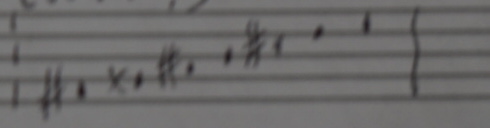
For practical reasons, I spelt that in a way that gives you one pitch class per note name (i.e. one A, one B etc., up to G).
Starting from B, I spell that:
B C# D E F# Gx A# (B)
If you would transpose that to start from D, it would read:
D E F G A B# C#
And that’s where the name comes from: it’s like Dorian (which, starting from D, goes without accidentals), but, like Melodic Minor, has the sixth and seventh step raised by a semitone.
Looking at the semitone intervals in this, we get:
2 1 2 2 3 1 1
Incidentally, it has the same distribution of 3, 2 and 1 steps as harmonic minor, but distributed in a different fashion.
So what’s the use of it?
As expected, the double sharp (in the transposition I showed above) leads to unusual appearances considering enharmonic shift. If you played a normal E triad here, like E-G-B, it would result in something that looks like an Esus4.
This is the scale used for the track Amazake.
Flat 4 Harmonic (Heptatonic)
Another heptatonic („normal“) one.
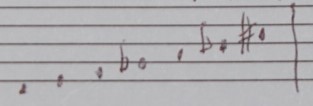
This time, I started writing that from D (because I really like D) as
D E F Gb A Bb C# (D)
Moving that to start from A, we get:
A B C Db E F G# (A)
It’s harmonic minor with a flat four.
For the semitone intervals this time, we get:
2 1 1 3 1 3 1
Two 3-semitone steps. That is slightly odd.
Interestingly, to the Western-classical-trained ear, this one appears more usual than the Melodic Dorian we discussed earlier.
It makes an appearance for both the samples of the acoustic piano and the electric bass guitar on Hastumode.
(Unnamed Octatonic One)
I don’t even know when I started needing this one. The closing track – Mehr. Ist. Weniger. – somehow called for it. Maybe because „more is less“?
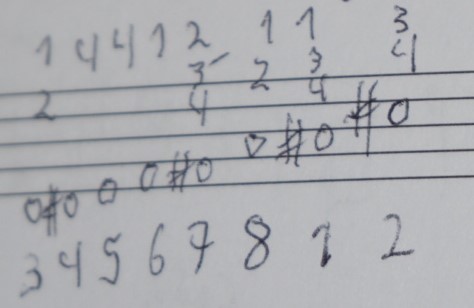
It’s octatonic, so there’s no reason to go wild with odd double-sharps and -flats, is there? The tonal centre on this one is ambiguous (as the numbers above tell you), I will transcribe for now from the starting D:
D D# E F F# A A# C# (D)
And, in semitone steps:
1 1 1 1 3 1 3 1
This looks outrageously silly. There are no wholetone steps, just a two three-semitone steps and semitone steps otherwise.
Which immediately begs the question: how does that relate to the other scales?
Scale Set Theory
As is easy to see, our Unnamed Octatonic is a true superset of Flat 4 Harmonic, but lives in another tonal world as Melodic Dorian.
Where did they even come from?
The Dorian Melodic and Flat 4 Harmonic were built on the idea on an anti-Hugo (Riemann, I did not want to call it anti-Riemannian, because that would anger Bernhard, and I don’t want that) harmonic progression where starting from D (I mentioned that I like that), I wanted to have major chords both a major third up and down.
And then considered wanting a B chord as well (voice-leading), hence Dorian Melodic.
Or to get this done properly, hence Flat 4 Harmonic.
The Unnamed Octatonic?
There was this short handwritten note for Mehr. Ist. Weniger. to start on the major third (from the first track Nicht. Zu. Viel.) and then end on a 7/13 on the double dominant tritone substitution for the root for the first track.
Which would need us to have D (major? or minor?) and a 7/13 on Gb.
That’s it for now.
How do they play?
Surprisingly well – try it!