
So there was this pedalboard that I wrote about. And I liked it a lot, but there were also things I didn’t like about it. Some had to do with individual components‘ performance, and some had to do with my architectural (both signal-flow and geometrical integration) choices.
So the idea for a Pedalboard 1.1 was always there. Which, over time, turned into something that we have to call 2.0. Something that I said would not happen, but that’s ok, because 1.0 continues to exist in a physical way.
What was wrong with 1.0?
- That footswitch used for switching the amp’s channel and boost had its cable attached, while all other things that connected to the amp had a jack.
- Also, said footswitch was way too large.
- I found that I only very rarely used the wah pedal. Which is a pretty large component.
- Things with the Zoom G3. The integrated loop recorder isn’t fun. It doesn’t offer true bypass. And sometimes I didn’t like „the sound“.
Design Ideas
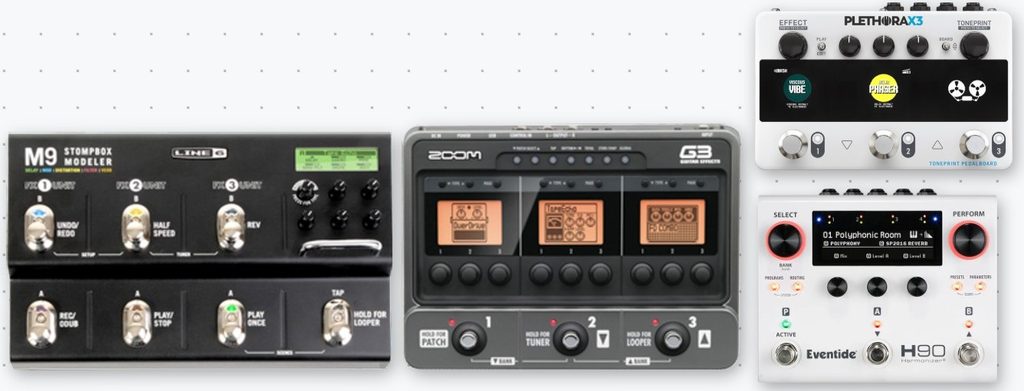
This resulted in some new design ideas. Removing the wah would have been easy, and I could just have sawn off the board. Same for replacing the footswitch. Somehow swapping the G3, however, would most probably require changes to more (including the PSU). So I made a bunch of drafts, looked at options for components. The footswitch was easy. For the G3 replacement, it turned out that the current-day competitor that people like is the TC Plethora X3. And I made a few mockups on pedalplayground.com.
And then I learned about Eventide’s H9Gen2, and followed up to look into the H90.
Which only gives you two effects at a time, but fancy ones. And it allows for some tricky input/output routing. Which would allow me to get rid of the loop switcher. Now we’re getting somewhere.
The Pedalboard 2.0
It had become clear by now that this deserved a major version number.
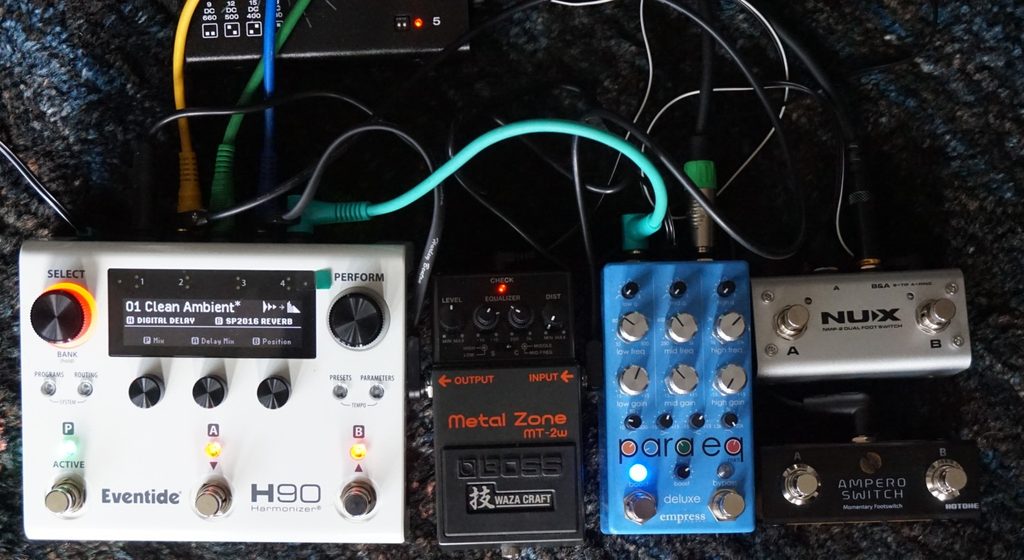
The H90 is the centre signal-flow-wise, doing the fancy effects and the insert routing. Having dropped the wah, we go from guitar into the ParaEQ, and from that into the H90.
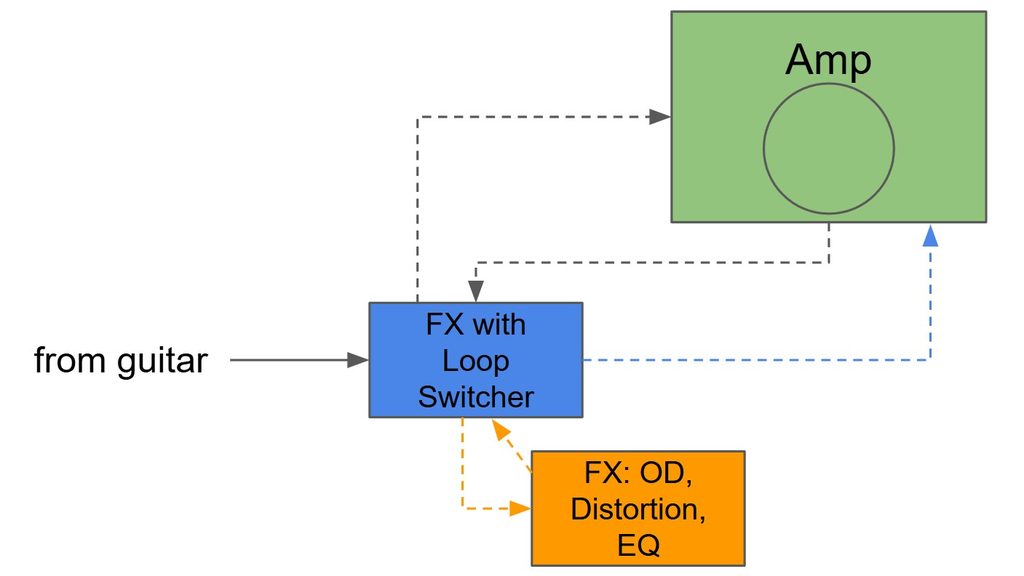
The H90 is configured to have the MetalZone in insert 1 and the ENGL’s preamp in insert 2, its output goes into the amp’s effects return. PSU is a Cioks SOL. Because I like Cioks, and the SOL is powerful enough for this setting.
Geometrical Integration
I opted for a handmade pedalboard again. And while not as cool as the two-tier solution, this time a simple „things in a row with PSU below the board“ approach.
An electrical hookup of the components looked promising.
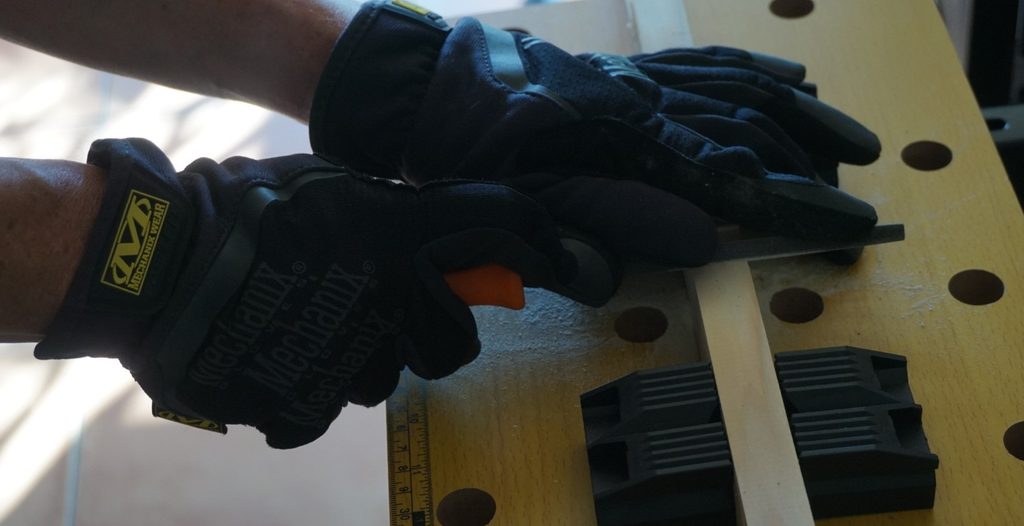
So I went to the hardware store and started building.
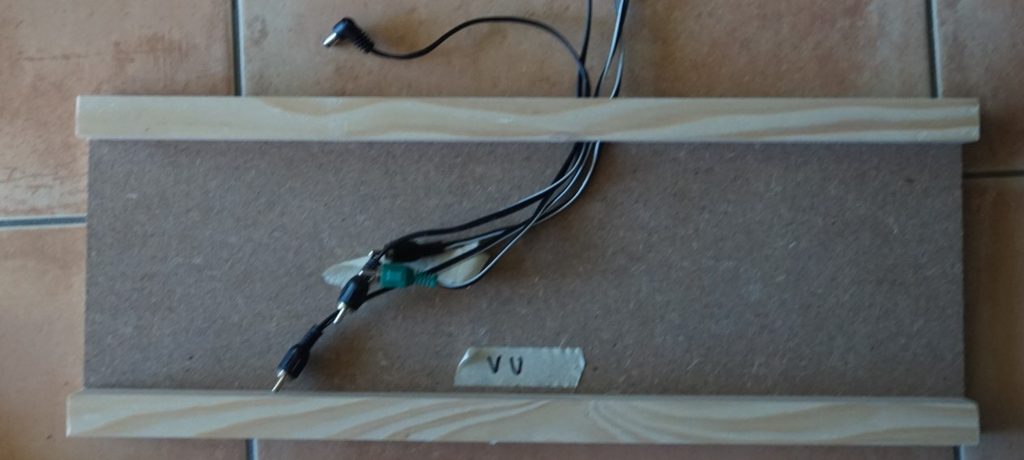
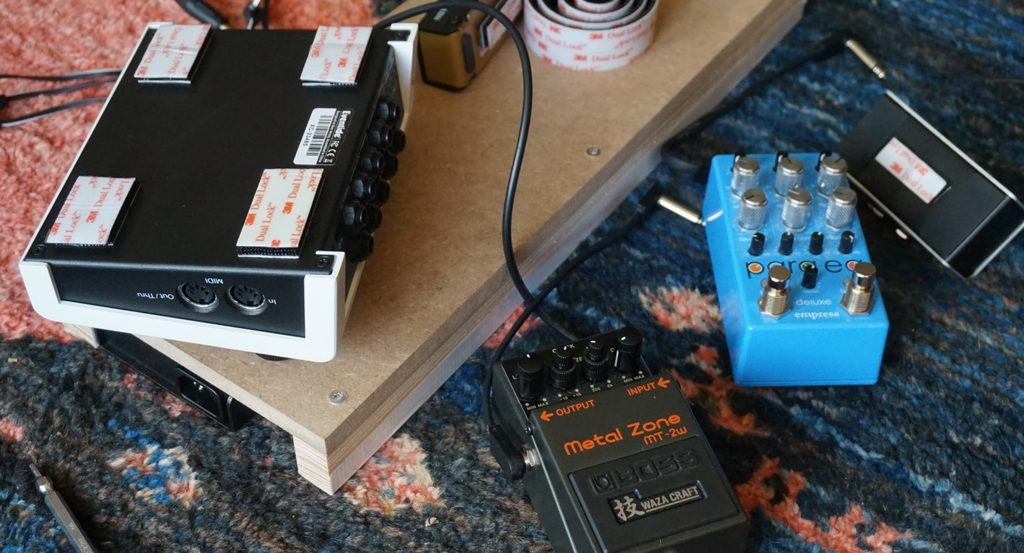
And voila!
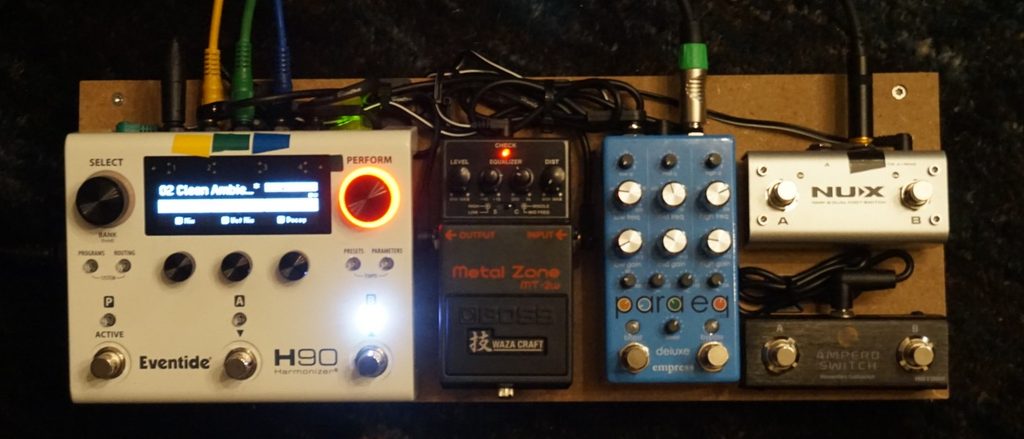
Experience
The big change was the move to the H90, not only in its role as a multi-FX-box, but also in replacing the loop switcher. I now got fancy Eventide effects, and the ability to have a flexible routing, like hitting one of the H90’s algorithm with the ENGL pre and the other with the Metalzone, or have the preamp in between both algorithms.
But I only have two algorithms, not three plus gate plus looper as with the M9, or up to five plus crappy looper as with the G3. But the algorithms are sometimes super-complex, and the H90’s looper is also a beast.
Gainstaging is also a topic, as I need to keep levels from the ParaEQ in check as they hit the H90 unless this one is bypassed, in which case the only possible path is straight to the amp.
So there’s a choice to be made: be really careful with the guitar’s volume knob when the ParaEQ’s boost is on and the H90 is not fully bypassed, or turn down the ParaEQ’s boost (thus not being able to achieve full-on poweramp distortion). I opted for the latter right now, but this can be changed by a twist of a knob.
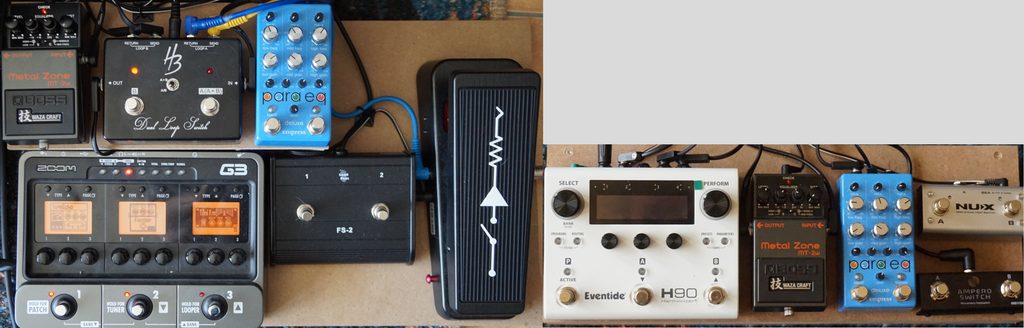
Size reduction: besides removing the wah, and the loop switcher, and having a smaller footswitch (but adding another one that I had lying around to switch the inserts), guitar multi-FX pedals have seen a downsizing trend. And it shows in the pedalboard. Which is nice. And the connections to the amp are colour-coded.
Will there be a new version?
I’m already thinking about a version 2.1, which simply would be replacing the generic cables with some that have the right length (and, in one case, angled as opposed to straight connector).
And there may also be an addition that would make it 2.5: adding a passive M/S matrix, so that rather than having everything in mono, I could send M to the power amp and S+/S- to a mixer/recorder and then go from the amp’s DI into the mixer for some perfectly integrated recording solution.