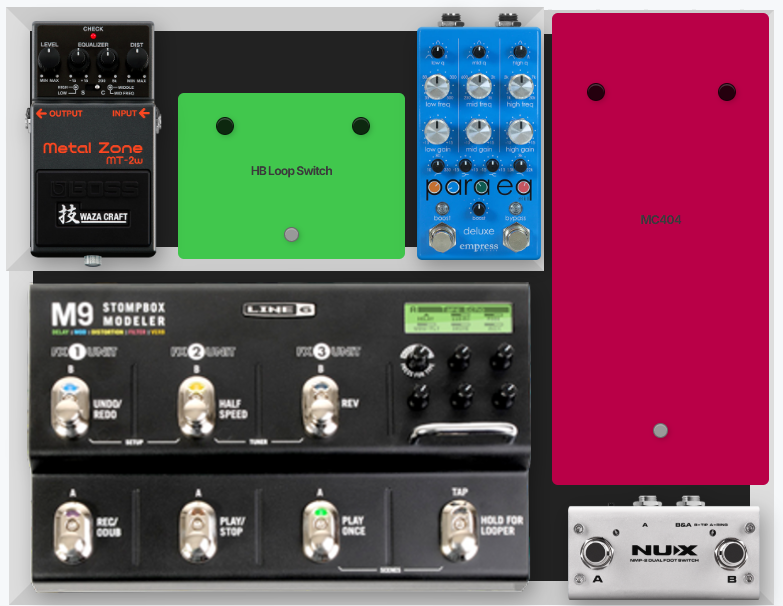
The other day, I told you how I built a pedalboard. Meaning I told you how I did this mechanically. But why did I choose those specific effects? Why do I use those at all? And how are they connected to the amp?
Let’s find out.
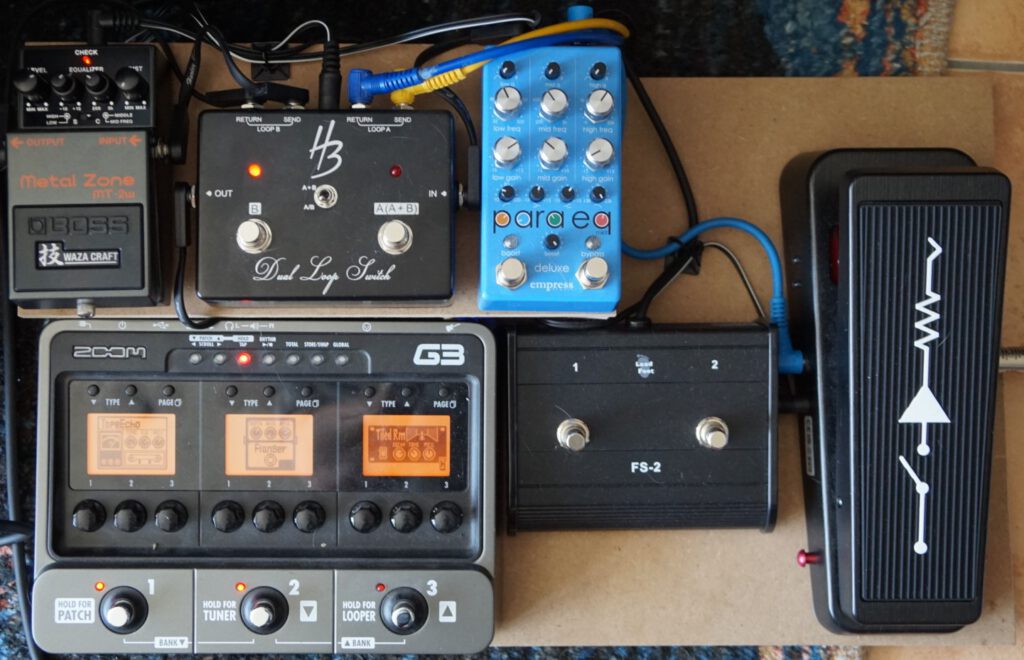
Since I wrote the first article, a tiny bit has changed: the Behringer UM300 went away, or rather was replaced by a Boss MT-2w MetalZone Waza Craft.
The Amp is Part of the Guitar
I believe that from a systems theory standpoint (and from a systemic standpoint), the amplifier and speaker cabinet are part of what we perceive as the instrument „electric guitar“ – making the electric guitar an acoustic instrument in the end.
Naturally, something changed in my use of electric guitars when I, for the first time in my life, won a proper guitar amp in a raffle. And not just any amp – a tube ENGL Steve Morse Signature 20. Which normally costs ca. 1500 bucks. And I also bought a cheap speaker for it. A 1×10“. Why? Because they sound better. Fact.
So this amp naturally has an input, and it has an effects loop. Meaning you can put effects between guitar and amp, or in the FX loop (meaning: between the preamp and poweramp portion of said amp). That’s the usual way to do.
The amp has two channels. I really like the clean channel (although „clean“ is, for all the non-guitarheads here, guitarspeak for „not completely overdriven“ from a THD perspecitve). It’s stunning, and goes from an almost-clean tone to a singing Santana-meets-Beck-one. It also has an 80s hair metal channel, and not exactly the kind of 80s hair metal I enjoy. So what to do? Use only the first channel, and stack distortion pedals into it? Or…
Excursion: The Cheapest Great Amp Channel in the World
One of the best-selling and at the same time most-misunderstood guitar pedal is the Boss Metal Zone. There was been some serious critizism of it – to which Boss product management replied with „it’s been the second-best selling pedal in our history after the DS-1, so what’s the problem?“
The problem is that some people use it as a distortion to stack into the hi-gain channel of an amp – while it’s just a hi-gain channel (with diode distortion) that just happens to be in pedal format.
And there’s a cheap knockoff of that timeless design – Behringer UM300 at around 28 bucks – which makes that the cheapest great amp channel in the world.
But what?s so great about it [MORE]?
There’s an in-depth circuit analysis on electricdruid.net, and I’ll be relying a lot on that for my case.
So what is that pedal? In a nutshell: input buffer, pre-gain fixed EQ (mid-centric), opamp gain stage (with 6-48dB of gain), symmetric clipping diodes, negative hi-shelf fixed EQ, post-gain fixed EQ (scoop), low-bell/high-shelf variable EQ and semiparametric mids EQ, followed by an output buffer. That’s a lot of EQ. And a lot of gain.
That minimum gain of 6dB, combined with the clipping diodes, means you’ll start to get distortion even at minimum gain unless you pluck the strings very very lightly or turn down the guitar’s volume. At the other end of the spectrum, you get fullon opamp saturation and diode clipping. And all of that with a lot of tone-shaping options.
Add to that that this has probably the most powerful EQ of any small pedal that is not a dedicated EQ, and you know you’re in for some serious options. And comparing that to your standard vintage amp – which ones of those has five EQs in total, and semi-parametric mids? Exactly.
There’s more: I already mentioned that it starts distorting even at minimum gain unless you turn the guitar volume down. But nobody keeps me from doing that. So if I also put a powerful clean boost in front of it, I can start of at a really nice clean sound, then turn up my volume knob for some light crunch, then kick in the boost for true metal mayhem. Nice!
In a nutshell: it gives me a full, separate amp channel with very deep tone controls, and if I pair it with a boost in front of it, it actually stands in for two channels with shared tone controls. Just like my amp. Only that the tone controls are more powerful, and I like the hi-gain sound better.
Strange Loop: Making this work with the Amp
What you sometimes read is that you need to feed the MetalZone into the effects loop. Which is nice and dandy, but how am I going to feed it into the amp, then? Replug the cable? Or use an AB box? But that way, I can’t properly use my amp’s effects loop anymore (into which I might want to put some modulation, or reverb, things). Unless…I do an inverse loop.
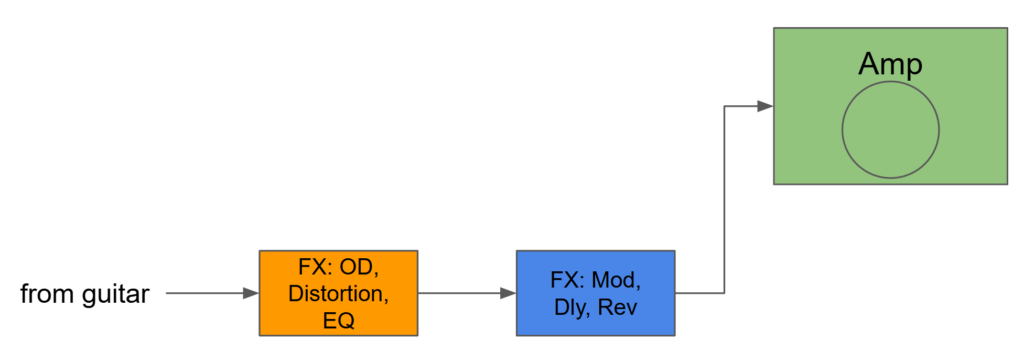
Consider this: an example of an amp with a bunch of pedals without amp FX loop or looper for the pedals [MORE].
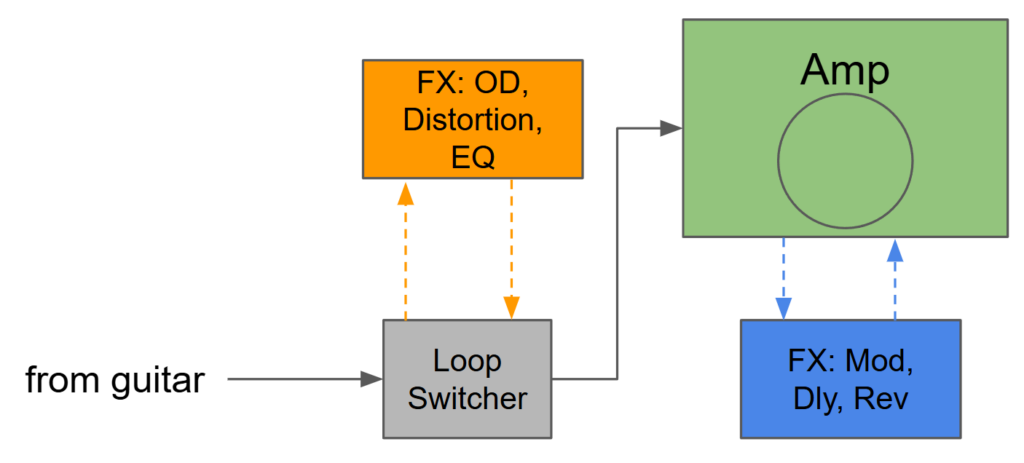
Now, the same setup, only with a looper for some of the pedals, and some pedals moved to the amp’s FX loop.
And now: the loops somehow got intertwined?
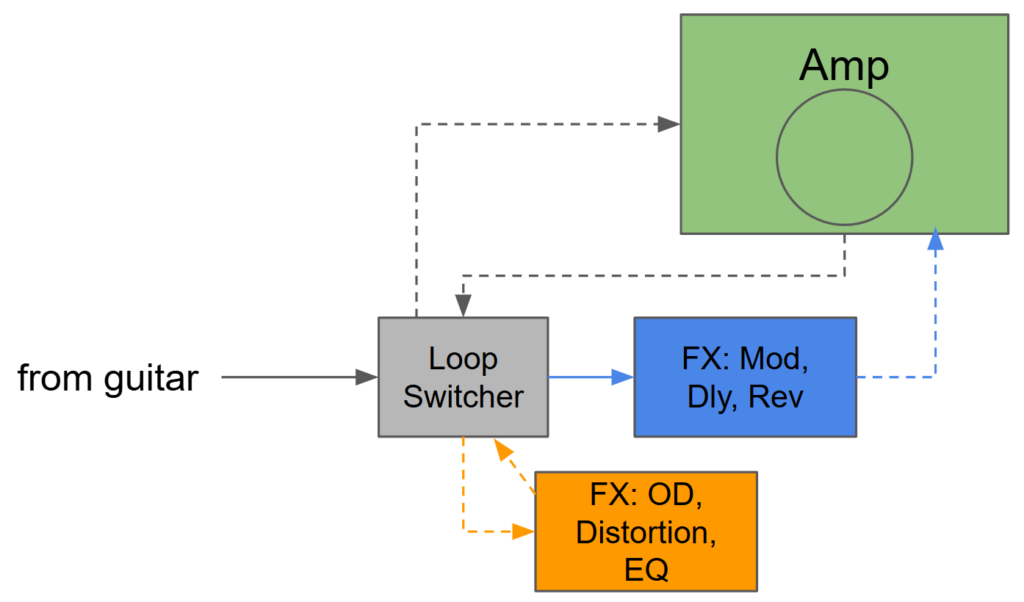
And that’s all of it: With a simple and affordable passive-signal-path two-loop looper, I intertwine guitar source, amp input, amp FX loop and pedals so that I can go:
- Guitar directly into the amp’s in (important for the tube nerds) and from there through the FX loop through part of the FX,
- Guitar into the UM300 and FX loop effects into the amp’s poweramp section,
- Same as 2, but without the UM300 (great for ultra-clean sounds).
That’s it! Call it an amp that suddenly doubled its channel count!
Other Pedals
Let’s start with the signal flow diagram and look at the pedals.
Dunlop/CAE MC404 Wah
It’s big, it’s not exactly designed with pedal-board mounting in mind, it’s not the cheapest, but it sounds nice. Also has two different voicings and a built-in boost.
Empress ParaEQ Mk.II Deluxe
Everyone knows that an EQ is the secret tone-shaping weapon, and most people have a Boss GE7 or a similar design for that. But what if your mindset is more of the studio rather than live sound gear, so you don’t like graphic EQs?
This pedal is what you want: three parametric bands, low/highshelf, low/highcut, and a separately switchable boost with up to 30dB. And it runs 18V internally, so that boost (and everything, really) is truly clean.
Downside? The Q is more on the focused side (minimum Q is 1.0), but – this one is a game-changer as they say, and makes for another – ultra-clean – channel in this setup
Harley Benton Dual Loop Switch
Loop one enters the amp’s guitar in, the return comes from the amp’s send. Loop two holds the Behringer UM300. A true centrepiece of this build. First loop switch is mechanical, the second is a realy (but according to the manufacturer’s spec, not made for long-time closed operation – what gives?)
Does the job.
Zoom G3
Multi-effects thing. Somewhat cumbersome in effects selection, mighty powerful with a healthy dose of odd things, and a simple looper in it. No true bypass (which is a problem, because it will distort if hit by the Empress‘ 30dB clean boost).
This is the second-best option after the Line 6 M9. Which I didn’t choose, because: reasons.
Additional Parts (not in signal chain)
There’s a Lead Foot FS-2 double footswitch. It switches the amp’s channels and boost. The cable is fixed to this. Which is silly.
And a Harley Benton Power Plant PSU. Which is big and sturdy, but only delivers 500mA total to 9V (silly). Also does the job.
Will there be a „Version 2.0“?
No. The way I like it is the way it is. As for small detail changes (moving into a version 1.1) though:
- I still think having the Line6 M9 after all would be nice. The power supply issue and dual-use-scenarios stood in the way. So if I had a pedal board with a) a PSU that can power the M9 as well and b) one that could hold either the M9 or G3…
- That Footswitch is a space hog. There’s much smaller variants. Which might make this much smaller.
I already drew something up in Pedal Playground. General design principle and signal flow is the same. I might realize this by sawing off the existing board and getting a fitting PSU.